
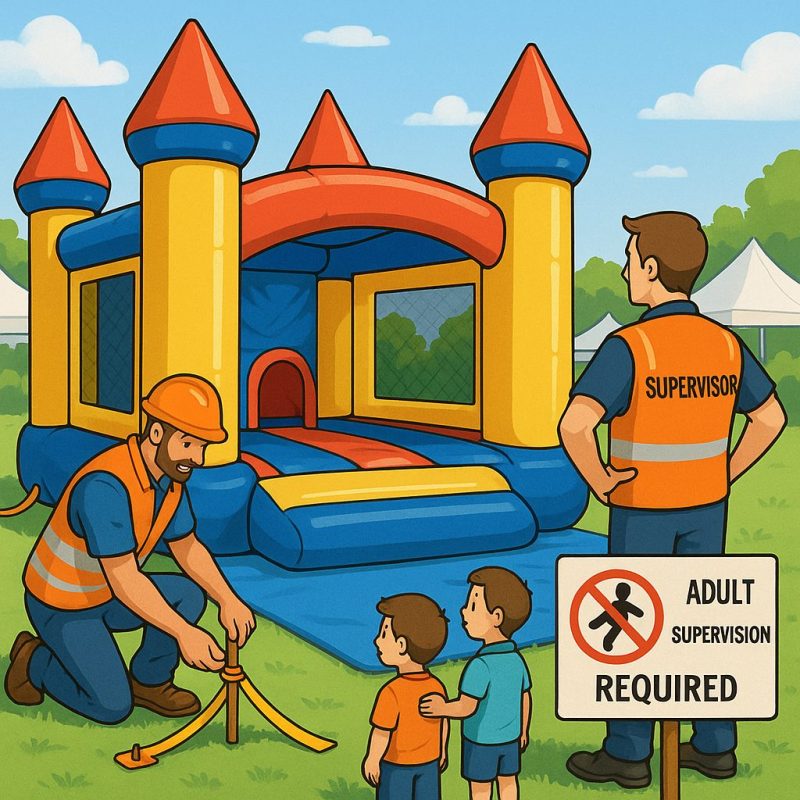
Inflatable attractions like jumping castles and slides can be the highlight of any community festival or corporate fun day. To ensure they bring joy safely and smoothly, event organisers must follow best practices when selecting, setting up, and supervising these crowd-pleasers. This step-by-step guide (tailored for Australian events) will walk you through everything from picking the right inflatable to anchoring it securely, all while complying with Australian safety standards. By the end, you’ll know exactly how to keep the bounce in your castle without any unwanted surprises.
Selecting the Right Inflatable and Supplier
Safety starts with choosing the right inflatable and a reputable supplier. Here’s what to consider:
- Size and Design: Match the inflatable to your audience and venue. For a community fair with young children, a small jumping castle with low walls and simple features might be ideal. For corporate family days or school fetes, you could opt for a larger obstacle course or inflatable slide that can handle older kids (and even adults). Always check the manufacturer’s specifications for dimensions and capacity – ensure your site can accommodate the inflatable’s footprint plus some clearance around it for safety mats and queuing.
- Commercial-Grade Quality: Use only commercial-grade inflatables for public events. These are built from heavy-duty, fire-retardant materials (like reinforced PVC) and designed to withstand continuous use. Avoid cheap retail or home-use inflatables for any sizable event – they aren’t made for crowds and might not meet safety standards. A quick way to verify: commercial inflatables are usually thicker, have multiple anchor points, and come with an electric blower; they should also have a tag or certificate stating compliance with safety standards.
- Australian Safety Standards Compliance: In Australia, two key safety standards apply to inflatables:
- AS 3533.4.1 – This standard covers land-borne inflatable amusement devices (e.g. jumping castles, slides) and sets requirements for their design, anchoring system, stability, and operation. For example, AS 3533.4.1 stipulates that a commercial jumping castle must withstand wind gusts up to 40 km/h when properly secured, and it addresses things like material flammability and the need for impact-absorbing mats at entrances and exits.AS/NZS ISO 8124.1 – This is the Australian/New Zealand toy safety standard (Safety of Toys, Part 1), which covers mechanical and physical safety for toys up to age 14. Large inflatables fall under this too, meaning they should be designed with child safety in mind (no sharp edges or pinch points, stable bouncing surfaces, etc.).
- Trusted Australian Supplier: Work with an experienced, Australian-owned supplier who prioritises safety. For instance, Australian Inflatables (a 100% Australian-owned company operating since 2016) is known for providing commercial-grade inflatables that adhere strictly to Aussie standards. A good supplier will help you choose the right unit for your event, provide guidance on setup, and ensure the equipment is clean and well-maintained. Choosing a trusted local supplier means you get gear designed for Australian conditions and support from people who understand local safety regulations.
- Accessories and Inclusions: Confirm what comes with the inflatable. You should have all necessary anchoring equipment (stakes, ropes, or sandbags), an appropriate blower, and possibly protective ground tarps or mats. If you’re hiring, ask if the hire package includes setup and pack-down by trained staff, and whether they provide supervision during the event. Some companies include an attendant or require that you use their staff (which can be a good thing for safety). Also, ensure you’ll have access to an instruction manual or safety guide for the unit.
By taking the time to select the right inflatable and supplier, you set a solid foundation for safety. Now, let’s look at how to get that bouncy castle from the warehouse to your event and set it up securely.
Safe Transportation and Handling
Inflatables are heavy, bulky pieces of equipment – a medium-sized jumping castle can weigh 80–200 kg and larger inflatable water slides even more. Transporting and handling them safely is crucial to avoid injuries or damage. Here are some tips for the journey from storage to site:
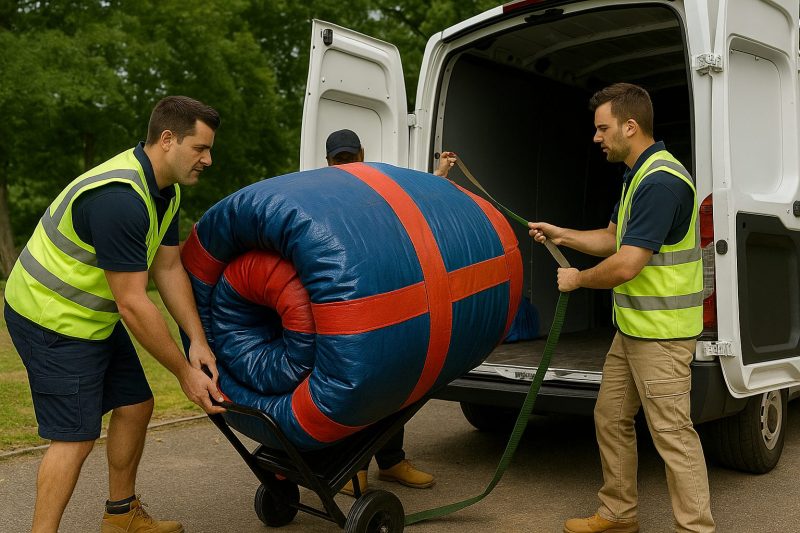
- Use Proper Vehicles: Always use a suitable vehicle (like a van, ute, or trailer) for transport. The inflatable, when rolled up, is often a cylindrical bundle that can be a metre or more tall and very heavy. Ensure the vehicle has enough space and load capacity. Never overload a vehicle or try to squeeze a large castle into a small car.
- Lift with Care: Treat a rolled-up inflatable like you would any heavy appliance. Team lifting is essential – have at least two or three people to lift and carry it. Bend your knees, keep your back straight, and lift slowly. If available, use a hand truck/dolly or a trolley to roll the packed inflatable from storage to the vehicle and at the venue. Many event organisers invest in a sturdy hand cart specifically for moving inflatables, to prevent back strain and accidents.
- Secure the Load: Once in the vehicle, strap down the inflatable so it can’t roll or shift during transit. Use ratchet straps or ropes to tie it to anchor points in the van/trailer. The blower and any loose items (stakes, mats) should also be secured or placed in containers – you don’t want heavy metal stakes sliding around. Driving slowly and carefully is obvious, but especially important with an inflatable in tow, as it’s an awkward load with a high center of gravity.
- Protect the Inflatable: If the inflatable will be transported in an open trailer or ute tray, wrap it in a tarp or protective cover to shield it from dust, rain, or road debris. Even a few minutes on a gravel road can grind dirt into the vinyl. Inflatables are durable, but sharp objects or abrasion during transit can still cause damage. Also avoid leaving it in direct sunlight for long periods before setup – the vinyl can heat up, which isn’t ideal when you’re about to inflate it (hot vinyl is more prone to stretching).
- Plan for Site Access: Consider how you’ll get the heavy inflatable from the vehicle to the exact setup spot. Are there stairs, narrow gates, or long distances across a field? Plan your route. It might be worth bringing along a small crew for the unload and carry, especially if the site is far from where you can park. Clear any obstacles en route. If indoors (e.g. setting up in a gym or hall), measure doorways to ensure the rolled inflatable fits through. Many a coordinator has been caught off-guard by a castle that couldn’t make it around a tight corner!
By handling the transport phase with care, you’ll arrive on site with your equipment – and your volunteers’ backs – in good shape. Next comes the main event: setting up the inflatable safely on site.
Site Preparation and Setup Planning
Before you unroll that inflatable, make sure your site is ready and safe. Good preparation prevents last-minute scrambles and hazards. Tick off these steps as you prepare your location:
- Choose a Flat, Level Surface: Inflatables must be erected on flat ground. A slight gentle slope can be manageable for some slides, but any significant tilt is dangerous – participants could bounce off unevenly or the inflatable could even tip. Grass is the ideal surface (it provides a bit of cushioning and you can stake into it). If you have to set up on concrete, asphalt, or indoors on a hard floor, ensure you have an anchoring plan (more on that soon) and padding for hard surfaces.
- Clear the Area: Thoroughly inspect the ground where the inflatable will sit, plus the surrounding safety perimeter (at least a couple of metres around). Remove rocks, sticks, sharp objects, or debris that could puncture the inflatable or trip participants. Also look up: check for overhead hazards such as low tree branches, roof eaves, or power lines. Never set up directly under power lines. You want clear vertical space at least a few metres higher than the highest point of the inflatable (remember, some slides or arches can be quite tall). Likewise, ensure no fences or poles are so close that the inflatable or a jumping child could hit them.
- Allow a Safety Perimeter: Plan for extra space around the inflatable. Leave at least 1.2 metres clearance around open sides for safety mats and for people to get on/off safely. This space also helps keep spectators from crowding the edges. If you’re using an inflatable obstacle course or a large interactive inflatable, you may need even more space for entry/exits or for participants to queue. Map out where the entrance and exit of the inflatable will be and keep those areas clear and accessible.
- Ground Sheet or Tarp: It’s often a good idea to lay a heavy-duty tarp under the inflatable, especially on abrasive surfaces (concrete) or dirt. A ground sheet keeps the bottom of the inflatable clean, reduces friction with the ground, and can protect it from wear and punctures. It can also catch some of the dirt from people’s feet, helping keep the bouncing area cleaner. Make sure the tarp is fully flat and taut – wrinkles can be tripping hazards. Fold or roll any excess tarp under the edges so it doesn’t stick out beyond the inflatable (exposed tarp could become slippery or a fuss for people walking by).
- Electrical Supply: Inflatables need continuous power for their blower. Identify your power source. Ideally, use mains power from a nearby building or generator. Safety first – in Australia, outdoor power outlets or extension leads for events must be protected by an RCD (Residual Current Device) to prevent electric shocks. If you’re running a cord from a hall or home, make sure an RCD is in the circuit (portable outdoor safety switches can plug in if the outlet isn’t already RCD-protected). Use heavy-duty outdoor extension leads and avoid daisy-chaining multiple cords. Plan the cord route from power to the inflatable: it should be out of walkways or taped down so people don’t trip. If the event is at night or cords run across publicly accessible areas, cable covers or matting over leads are wise.
- Weather Check and Backup Plan: Check the weather forecast for your event day (and a few days before, in case you need to adjust plans). If strong winds, storms, or extreme heat are predicted, have a contingency – you might need to relocate indoors, delay the inflatable portion, or have extra staff on hand to assist. Some organisers set up inflatables only if morning weather checks look favourable. Also consider shade and sun: the Aussie sun can heat inflatable surfaces quite a bit, so if possible, position the inflatable where part of it gets shade either naturally or from a marquee (without violating the overhead clearance rule). At minimum, advise parents to have kids wear socks (to avoid hot feet on vinyl) and keep some water handy for thirsty jumpers.
- Permits and Permissions: If your event is on public land (like a council park), ensure you have permission to set up the inflatable. Councils often require evidence of public liability insurance and may have specific safety guidelines you must follow. Some even ask for an “engineer’s sign-off” or documentation that the device meets standards. Handle these admin tasks well in advance so there are no surprises on event day. Furthermore, large inflatables (platform height 3 metres or more) are considered amusement devices that may require design registration with state authorities – if you’re hiring from a professional supplier, they will typically handle this, but if you own the inflatable, check the regulatory requirements in your state.
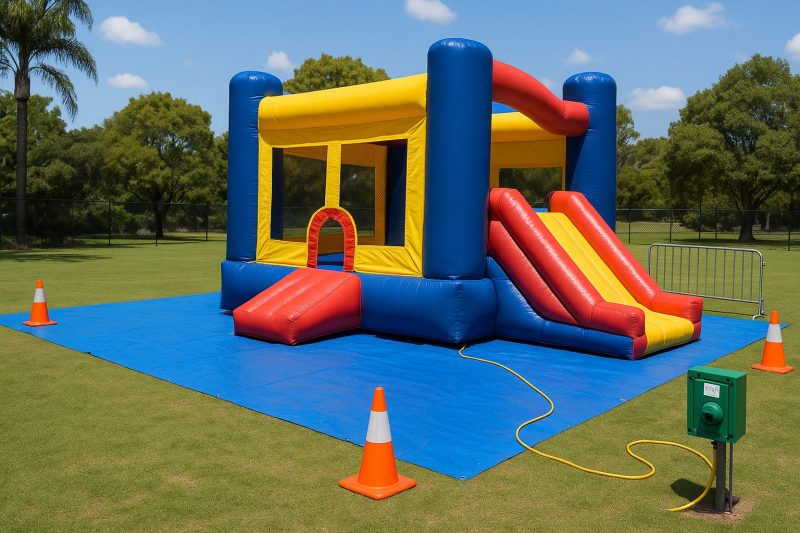
With the site prepped and the logistics sorted, you’re ready to bring your inflatable to life. In the next section, we’ll go through the step-by-step setup and how to secure everything firmly in place.
Step-by-Step: Setting Up the Inflatable
Setting up an inflatable is straightforward, but it must be done methodically to ensure safety and longevity of the equipment. Work with at least one other person if possible – it makes the process easier and safer. Below is a step-by-step guide:
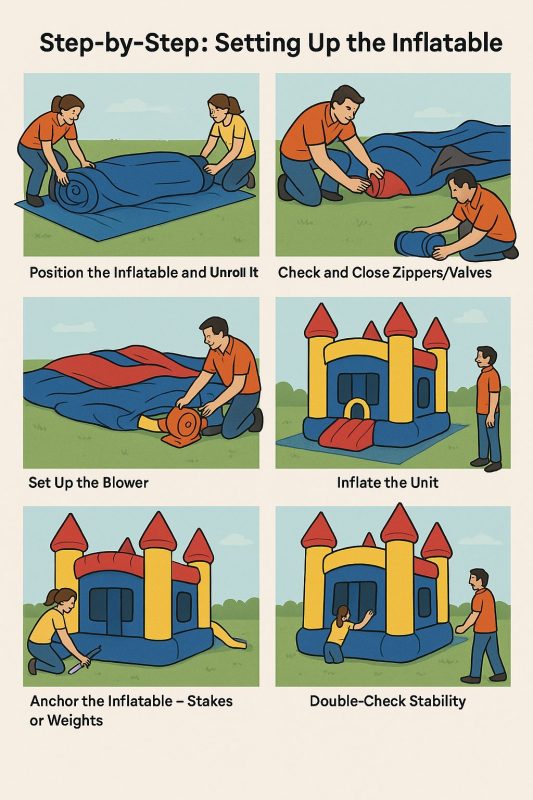
- Position the Inflatable and Unroll It: Carry the rolled-up inflatable to the center of your prepared area. (Tip: If it’s really heavy, roll it on the tarp to get it roughly in place rather than lifting fully.) Orient it so that the entrance faces where you want the crowd to queue. Once in position, undo any straps and unroll the inflatable completely flat. Spread out any attached extension pieces (like slide landing mats) as well. Take a moment to inspect the fabric as you unroll it – look for any obvious tears or loose stitching (if found, do not proceed with inflation until repaired).
- Check and Close Zippers/Valves: Most commercial inflatables have air release zippers or flaps (usually at the base) to help with quick deflation later. Ensure all these zippers are closed or velcro flaps secured before inflation, or the castle won’t fully inflate. Also locate the inflation tube (a long fabric tube where the blower will connect). It should be on the side or back. Untie or unzip it if it was secured, and make sure it’s free of twists.
- Set Up the Blower: Place the electric blower at the end of the inflation tube. Ideally, the blower sits on dry, level ground a few feet away from the inflatable. If on grass, ensure it’s a spot where it won’t suck in loose grass or dirt. Attach the blower’s output nozzle to the inflation tube securely – usually the tube goes around the blower mouth and is secured with a strap or belt clamp. Double-check the blower’s power cord length and connect it to your extension lead (which should already be run from a power source with RCD protection as discussed). Before turning on, ensure the blower switch is in the OFF position, and that no one is inside or on top of the folded inflatable.
- Inflate the Unit: Power on the blower and watch the inflatable come to life. It will start rising within seconds. As it inflates, keep people well clear – occasionally straps or parts may flick out. Guide any floppy sections if needed so they don’t catch on anything. Important: Do not leave the blower unattended during inflation. In a minute or two, the structure should be fully raised and firm. The blower is designed to run continuously; inflatables are not airtight (air is constantly escaping through seams and the slight gaps around zippers) so continuous airflow keeps it pressurised. Listen for any unusual sounds from the blower (a loud rattle might indicate it’s ingesting something or a loose part) and make sure the air intake isn’t blocked (some blowers have an intake filter – ensure it’s clear).
- Anchor the Inflatable – Stakes or Weights: Once the inflatable is up, immediately secure it at all anchor points. This is a critical safety step. Most inflatables have multiple anchor points around the base (and sometimes at mid-height on tall structures). They’ll be in the form of fabric loops or D-rings. For grass/earth setups: insert metal stakes through each anchor point loop. Drive the stakes deep into the ground at a 45° angle away from the inflatable (this angle provides the best resistance). Leave only a small portion of the stake exposed and make sure the rope or strap attached to the loop is taut. Use a hammer or mallet, and watch out for underground utilities (if you’re not sure what’s below, don’t hammer stakes deeper than about 30cm, or use weights instead). For hard surfaces: if you cannot stake into the ground, use heavy weights such as sandbags or water barrels attached to every anchor point. As a rule of thumb, use at least 2 x 20kg sandbags (or equivalent) per anchor point, though larger inflatables may require more. Place weights in a way that the rope/strap from the inflatable to the weight is at a low angle (to reduce any sideways force). If you’re unsure about anchoring on a hard surface, consult an experienced rigging professional or the inflatable supplier – safety must not be compromised. Indoors, even though wind isn’t a factor, anchoring is still required to prevent movement or tipping due to enthusiastic play. Never skip or ignore an anchor point because “the inflatable seems stable enough” – every provided point is there for a reason.
- Double-Check Stability: Walk around and give the inflatable a gentle push at different sides and corners. It should feel well secured, with minimal tilting or shifting. Tighten any slack ropes. Check that stakes are firmly in and not wobbling (if a stake hits a rock and can’t go fully in, relocate it if possible, or use a weight on that point as a backup). This is also a good time to ensure impact-absorbing mats are in place at entry/exit points. If the front of the castle is open for kids to climb in, place foam or rubber mats on the ground extending out from the entrance. That way if someone tumbles forward, they land on a padded surface, not bare ground. Similarly, at the bottom of a slide exit, have a mat where kids land.
- Secure Blower and Cords: We don’t want anyone tripping over or tampering with the blower. Use cones or temporary fencing to cordon off the blower area. Many events use a simple barrier or even a mesh fence panel around the blower and generator (if one is used). This prevents kids from wandering up to the noisy machine out of curiosity. All electrical cords should be either buried (if possible on a field), covered, or at least routed out of foot traffic paths. Also, weather-protect the blower if there’s any chance of rain or splashes (a plastic cover or bin can work as a shield, but ensure the blower’s air intake isn’t obstructed).
- Inspect the Inflatable Fully: Now that it’s inflated and anchored, do a thorough inspection before opening it up to the public. Walk the perimeter: check that all seams are holding, no air is leaking excessively from any zipper (a little hiss is normal, but a gaping zipper will need re-sealing). Ensure the structure looks symmetrical and not sagging in any section (sagging could indicate a blower issue or an open vent). Climb inside (with the blower on) and examine the interior for any hazards – no leftover objects, no rough edges. Check that steps (for slides) or climbing features are securely attached. If there are netting windows or walls, see that they are properly secured and not torn. Lastly, test the emergency exits or deflation plan: know where the blower switch is and how to quickly unzip a deflation panel in case you need to deflate rapidly. It’s best to familiarise yourself now rather than during a crisis.
- Set Up Rules Signage: If you have a rules board or sign (which is highly recommended), place it at the entrance now. List the key rules (more on these rules in the next section) in clear, large text. This sign can prevent arguments later (“But I didn’t know we couldn’t do flips!”) and gives everyone the same expectations for behaviour on the inflatable.
- Final Safety Briefing to Staff/Volunteers: Gather your supervisors or any staff who will be manning the inflatable. Go over the plan: How many people are allowed on at once? What are the age or height limits? How will you communicate if someone needs to come off? Assign roles – for example, one person to manage the entrance (letting people on one by one, checking for shoes removal), and another to watch the overall play or manage the exit. Ensure each person knows the location of the blower off switch and any emergency whistle or signal system you have for evacuation. If you have walkie-talkies or phone contact between event staff, confirm those are working too. Now you’re almost ready to open for fun!
With the inflatable up and secured, and your team briefed, the physical setup is done. Next, it’s all about maintaining a safe operation while the inflatable is in use.
Supervision and Safe Use During the Event
Having the inflatable set up correctly is only half the safety equation – the other half is diligent supervision and management while people are bouncing and sliding. Accidents can happen if rules aren’t enforced or if the device is not monitored. Here’s how to keep things under control:
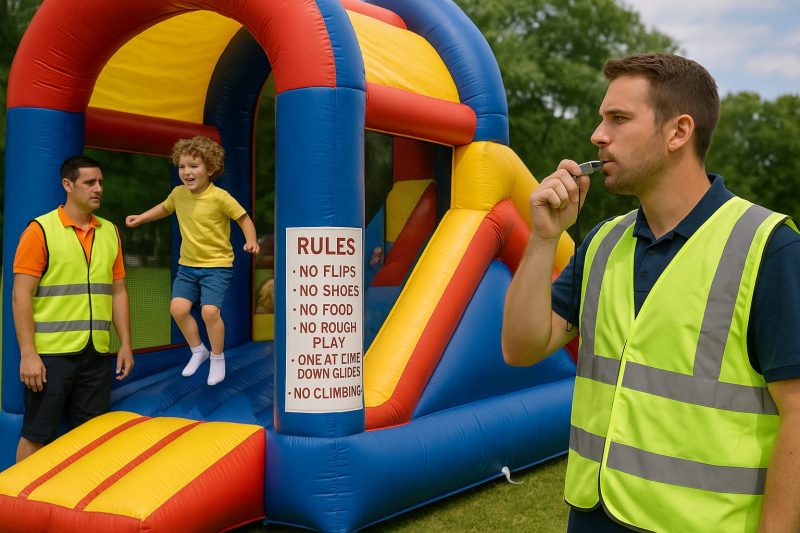
Dedicated Supervisors: Always have at least one, preferably two, responsible adults supervising a commercial inflatables at all times during use. Their entire job is to watch the inflatable and its occupants – not to be chatting away or distracted by other tasks. For larger inflatables or very busy events, increase the number of supervisors. For example, a big obstacle course might have one person at the start, one at the middle (roaming), and one at the end. Make sure supervisors are easily identifiable (bright vest or staff shirt) and are briefed on the rules and emergency procedures. They should also ideally have a means to communicate with each other or event security (two-way radios or phones).
Enforce Entry Rules: At the entrance, the supervisor should control the flow of participants. Typically:
- Remove shoes and sharp items: Everyone must take off shoes, remove any sharp objects from pockets, and ideally remove glasses/jewellery if possible (to prevent injury and damage). This also includes removing bobby pins or anything in hair that could fall out.
- Check numbers: Only allow the maximum safe number of users on the inflatable at once. This number is usually given by the manufacturer (e.g. “Max 8 kids” or “Max 4 adults” at a time). Never exceed it, even if there’s a queue – it’s better to rotate people quickly than to pile too many inside.
- Size grouping: If you have a mix of big kids and little kids waiting, it’s wise to separate their play sessions. A tiny five-year-old and a burly 12-year-old should not be bouncing together – the smaller child could get injured. So you might, for instance, allow only similar-sized kids per session or dedicate separate time slots for different age groups. Use common sense based on who’s in line.
Rules on the Inflatable: Once on, participants need to follow basic safety rules. Make sure your supervisors communicate these rules clearly. Common bouncy castle rules include:
- No flips or somersaults: Absolutely no one should attempt flips, somersaults, or other acrobatics. It’s a leading cause of head, neck, and back injuries on inflatables.
- No rough play or wrestling: Pushing, tackling, or wrestling can quickly lead to injuries. Stop any rough behaviour immediately.
- One at a time down slides: If your inflatable has a slide, only one person should slide at a time, and always feet-first, sitting up or on their back. No head-first diving down slides.
- No climbing on walls/towers: Participants should not climb or hang on the outside walls or the netting of the inflatable. It can tip the structure or cause them to fall off.
- No food, drinks, or gum: Aside from being a choking hazard, spills make the surface slippery and sticky.
- No flips into entrances/exits: Some kids get creative and try to dive out the entrance – that’s dangerous. Make sure they calmly exit and no one jumps off the inflatable onto the ground.
- Keep it age-appropriate: Adults or teens shouldn’t be on a kiddie castle with toddler-sized kids, and vice versa, unless the inflatable is specifically designed as all-ages and the play is gentle. When in doubt, separate by size.
Your supervisors should actively enforce these rules. Often a quick whistle or a friendly but firm “Hey guys, no tackling please!” will do. If certain individuals keep breaking rules, don’t hesitate to have them take a break or leave the inflatable – safety comes first.
Monitoring the Inflatable’s Condition: While supervising, also keep an eye on the inflatable itself. Check that the blower is running continuously. If you notice the inflatable softening or sagging, it could be a power issue or an airflow blockage – act fast: calmly but quickly clear all participants off and then investigate the issue (it might be a tripped power cord or someone moved a weight off a tube). Also watch the anchors if visible; stakes can sometimes loosen from vigorous movement or if the ground is very soft. If a stake pops out, clear the castle and re-secure it before resuming play.
First Aid and Emergencies: Be prepared for minor injuries – have a first aid kit on hand. Typical incidents might be a bumped head or scraped knee when climbing in or out. For any injury that seems more than a trivial bump, stop the ride and get appropriate medical attention. In your event planning, you should have first aid officers or a first aid tent available. Make sure supervisors know where to direct people in case of an injury. Thankfully serious injuries on inflatables are rare when rules are followed, but being prepared is part of responsible management.
In summary, active supervision and clear rules will prevent most mishaps. But there’s another big factor that can affect inflatable safety even beyond your control: the weather. Let’s discuss how to handle that.
Weather Considerations and Wind Safety
Australia’s weather can be unpredictable. A sunny morning can turn into a blustery afternoon. Wind in particular is a critical concern for inflatables. There have been tragic incidents (including one in Tasmania in 2021) involving jumping castles becoming airborne due to strong gusts. As an event organiser, you must keep a keen eye on weather conditions and be ready to act. Here’s how to stay weather-wise:
- Monitor Wind Speeds: Wind is the enemy of inflatable structures. Even when well-anchored, a powerful gust can exert enormous uplift forces. SafeWork Australia and state WorkSafe bodies advise evacuating and deflating inflatables if wind gusts exceed the manufacturer’s specified limit, or 40 km/h in absence of guidance. It’s prudent to start caution at even lower speeds (many operators use 30 km/h as a soft limit). Use a handheld anemometer to measure wind on site – do not rely solely on the general weather report, as conditions on the ground can differ. Check periodically (say, every 15-30 minutes) or have continuous monitoring if possible. Wind can pick up suddenly, so vigilance is key.
- Know the Signs: Long before a gust hits 40 km/h, you’ll often see cues: leaves rustling more vigorously, flags whipping, tents flapping. If you notice weather conditions worsening, consider a temporary shutdown as a precaution. It’s easier to pause activities and let a squall pass than to react to an emergency. Remember, wind can be very localised – a storm front could bring one strong gust out of nowhere. Always err on the side of caution with inflatables and wind.
- Hot Weather and Sun: Heat doesn’t typically threaten the structure’s integrity (commercial inflatables are made to handle Australian heat and UV), but it can affect participants. On very hot days, the vinyl can become hot to touch, and children can overheat or dehydrate quickly from vigorous play. To mitigate this, provide shade if possible (a shade sail or umbrellas near the inflatable’s queue area), allow regular rest breaks, and have water available. Also, if the inflatable is in direct sun, check the surface temperature and consider closing it during peak sun if it gets too hot for comfort (some operators cool them with water misters, but that might not be practical at all events).
- Rain and Storms: Rain itself isn’t usually a structural danger – inflatables can get wet (though it makes them slippery). The bigger concern is that rain often comes with wind and lightning. If a thunderstorm is approaching, clear and deflate the inflatable immediately. Lightning poses an obvious risk to any large structure, and winds can ramp up suddenly around storms. Even moderate rain without high winds can be problematic: water collecting on top could strain the seams, and puddles inside are slip hazards. If you do get a surprise shower, pause the activity and let the rain pass. Dry the entrance and interior with towels as much as possible before resuming, to prevent slips.
- Evacuation Procedure: Plan in advance how you’ll get people off and the inflatable deflated quickly if weather hits. Typically, if wind thresholds are met or lightning starts, the steps are: Whistle/blow horn to get everyone’s attention, instruct participants to exit calmly immediately, once clear, turn off the blower and open the deflation zippers to speed collapse. Having multiple staff helps – one can manage the crowd while another handles the blower. Practice this mentally (or even as a drill before the event opens). Time is of the essence when a gale is coming.
- Post-Weather Inspection: If you shut down for weather and later conditions improve, inspect the inflatable thoroughly before re-opening. Check that all anchors are still secure (stakes can loosen in soggy ground), the unit hasn’t shifted, and the blower is dry and functioning. Never re-inflate if winds are still near the limit – wait for genuinely calm conditions.
A good mantra is: “If in doubt, take it down.” Yes, it might disappoint a few folks, but safety must trump all. Communicate this in your event announcements if needed (“Due to strong winds, the jumping castle will close until further notice for everyone’s safety”). Most people will understand – after all, nobody wants to recreate the scenes they’ve seen on the news.
Crowd Management and Operational Tips
At popular events, an inflatable can attract a crowd. Managing that crowd isn’t just about fairness and fun, it’s also tied to safety. A disorderly queue can lead to pushing, or kids sneaking on without supervision. Here are strategies to keep things organised and enjoyable:
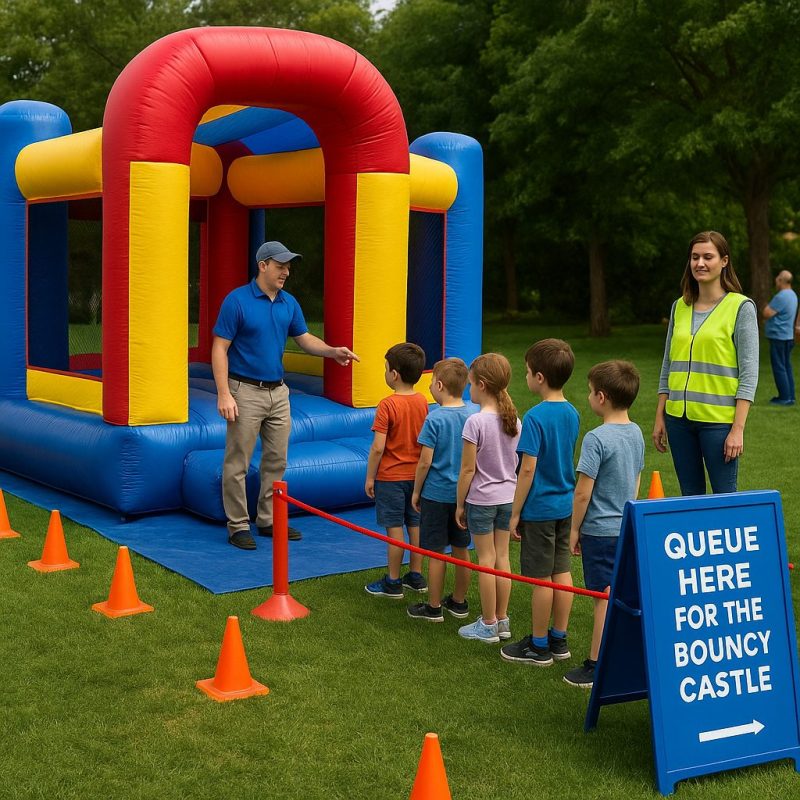
- Set Up a Clear Queue Area: Use cones, rope, or temporary fencing to establish where people should line up. This prevents a chaotic mob around the entrance. A single file line leading to the attendant is ideal. You can also use signage like “Queue here for the Bouncy Castle” to direct people. Ensure the queue doesn’t block other attractions or walkways. If space allows, having a separate exit point on the opposite side is great so that incoming and outgoing kids don’t collide. If the design only has one entry/exit, then have the attendant regulate that flow carefully (for example, “One out, one in” rhythm).
- Implement Session Rotations: To give everyone a fair go, especially with large crowds, consider running timed sessions. For example, allow 5 minutes of play for a group of, say, 6 kids at a time. The supervisors can then whistle and have everyone exit to let the next group on. This “round-based” approach ensures turnover and can actually improve safety (smaller group inside at once). You might announce it as: “We’ll take the next 6 kids for a 5-minute play, then swap.” Most parents and kids appreciate knowing they’ll get a turn and for how long. Use a stopwatch or phone timer to keep track of sessions. Keeping sessions short also means kids don’t get too exhausted or overheated on hot days.
- Ticket or Wristband System for Big Events: If your inflatable is one of many activities at a big event (like a council festival or corporate family day), people might not want to stand in line forever. One method is a ticket system – hand out numbered tickets for time slots or order of go, so families can wander and come back when it’s their turn. Alternatively, coloured wristbands for specific time blocks can work (“Blue bands can use the castle from 1:00–1:15pm”, etc.). This requires a bit more organisation and communication, but it can prevent massive queues and frustration. If you do this, have clear signs or an MC announcement explaining how it works.
- Adequate Staffing: Ensure you have enough people not just for supervision, but also for crowd management. One person should really focus on watching the kids on the inflatable (to enforce rules), while another handles the queue (to brief the next group, check they’ve removed shoes, etc.). If you only have one person, they will be stretched thin trying to do everything, and that’s when things can be missed. For very popular attractions, even a third person as a “rover” can help manage the crowd waiting, answer questions, or step in to give other supervisors a short break.
- Keep Spectators at a Safe Distance: You might get eager parents clustering near the exit with cameras or friends trying to chat with kids through the sides. Politely keep them a short distance away. Not only can an excited adult leaning on a side wall cause that side to collapse or over-stretch, but in an emergency you need clearance to evacuate the inflatable. Use a simple barrier or cones to indicate a “no standing zone” around the inflatable (except for the entrance queue). Plus, giving a bit of space ensures that if a child does fall out or jump off unexpectedly, they don’t crash into someone immediately next to the inflatable.
- Entertainment During Wait: This is more of a nice-to-have, but if kids are waiting in line, consider ways to keep them patient. Maybe have an assistant doing quick trivia or line games, or provide a few hula hoops or a mini activity nearby so queuing kids don’t get restless and start misbehaving. Happy, occupied kids in line are less likely to break the rules once on the inflatable too.
- Accessibility and Inclusion: If any participants have special needs or require assistance, have a plan to accommodate them. This might mean pausing the queue to allow a child with a disability extra time or help to get in and enjoy the inflatable safely. Brief your team on being inclusive and patient – community events should be fun for everyone, and a small adjustment can make a big difference for someone who needs it.
A well-managed crowd not only makes for a more pleasant event but directly contributes to safety by reducing chaos. People will appreciate the clear organization and it reflects well on the event as being professionally run.
After the Fun: Safe Deflation and Pack-Up
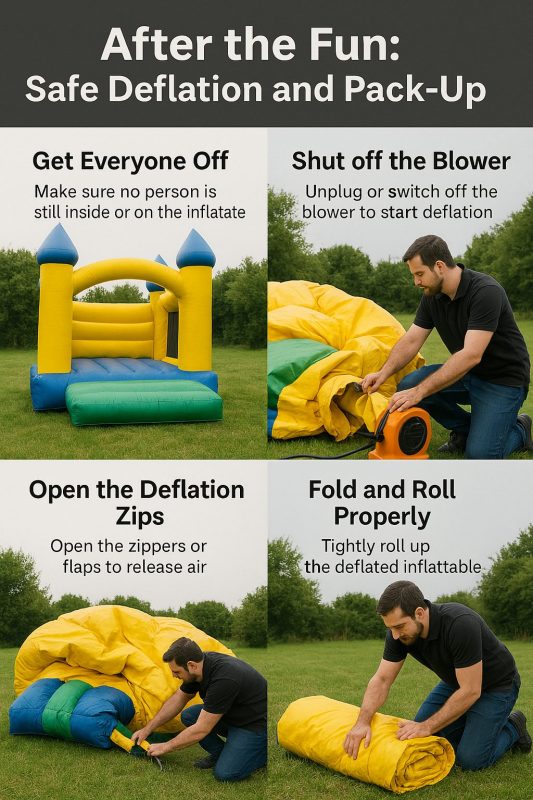
Once the last bounce is bounced and it’s time to pack up, don’t rush through the takedown. Deflating and packing the inflatable safely ensures the equipment stays in good condition and that no one gets hurt at this stage. Here’s how to wrap it up:
- Get Everyone Off: Sounds obvious, but make absolutely sure no person (child or adult) is still inside or on the inflatable. Check any nooks (some obstacle courses have tunnels where a child could hide). Never start deflating until the structure is completely clear of people and any loose personal belongings.
- Shut off the Blower: Unplug or switch off the blower to start the deflation. If the blower is petrol-powered (some large ones are), cut the engine. As the air flow stops, the inflatable will begin to sag. Let it collapse naturally – do not rush in to push it down while air is still coming out relatively fast, as the material can billow and hit you. Many inflatables will fold down largely on their own.
- Open the Deflation Zips: As the inflatable softens, open the large deflation zippers or flaps (usually located at base sections) to speed up the process. Be ready for a big whoosh of air. You might need to hold the flap open until the air is mostly out. If it’s a very large unit, opening multiple vents will help. Important: While deflating, keep bystanders (especially children) at a distance. Kids often are drawn to a collapsing castle (it looks fun to jump on) – you must not allow anyone to do so, as there’s a suffocation risk if someone gets entangled in the deflating fabric.
- Detach and Secure Equipment: Once the inflatable is down and mostly flat, turn your attention to the blower and power. Unplug the blower from the extension cord (and turn off the power at the source for extra safety). Detach the blower from the inflation tube. Immediately put any protective covers back on the blower’s inlet/outlet if it has them, to prevent debris or rain getting in during transport. Coil up extension leads, collecting any power boards or RCD devices. It’s best to get the electrical gear out of the way before you start rolling the inflatable, to avoid someone tripping over cords while carrying heavy vinyl.
- Remove Anchors Carefully: If you used stakes, use a crowbar or stake-puller tool to loosen and remove them – don’t just yank by hand if they’re deeply embedded. Watch your footing so you don’t twist an ankle on partially exposed stakes. As each stake comes out, store it in a bucket or bag (they can be muddy, so have something to contain them). For weighted anchors, disconnect any ropes and move the weights aside. Sandbags might have to be hauled off or emptied; water barrels can be emptied after disconnecting. Be mindful of your lifting technique here, as fatigue at the end of the day can lead to sloppy lifting – and injuries.
- Cleaning and Drying: Take a quick look at the inflatable’s surfaces as you prepare to fold it. If it’s dirty (and it likely will have some grass, leaves, or dirt), try to brush off debris. If there are any wet areas (from rain or just kids’ spillages), towel them dry if possible. Inflatables should be stored dry to prevent mildew. At a minimum, note any wetness so you can fully dry it later at the warehouse or open it up at home for cleaning. Some event teams carry a broom or soft brush to sweep out the inside after use – kids might leave small items or dirt inside.
- Fold and Roll Properly: Folding an inflatable can be tricky, but doing it right extends its life and makes it easier next time. Typically, you’ll fold the sides to the center (lengthwise) so that the width of the folded inflatable is about the length of the storage bag or just manageable to carry. For example, fold long sides in, maybe fold again if it’s very large, until you have a long narrow strip. Then roll tightly from one end (often the front) toward the opposite end where the inflation tube is, squeezing out air as you go. If air is trapped, pause and open vents or redo folds to let air escape. The tighter and more evenly you roll, the easier it will be to handle. This often takes two or more people – one to kneel on the roll to compress it, another to push the roll along. Go slow and maintain pressure to get a compact roll. Once done, use the straps that came with it (or ratchet straps) to tie it up so it doesn’t unroll.
- Load Safely: Use a trolley or team lift to get the rolled inflatable back to your vehicle. Remember, everyone’s likely tired now, so consciously use good lifting technique and communicate with your teammates (“Ready? 1, 2, 3 lift”). If it’s dark, ensure you have adequate lighting for this teardown phase to avoid trips or mistakes. Load the blower and all accessories, double-check the site for any forgotten items (stakes hiding in grass, leftover tape, personal items). It’s good practice to do a headcount of equipment: you should have the same number of stakes, straps, and parts as you started with.
- Post-Event Inspection: Later, when you have a chance, inspect the inflatable for any damage or excessive wear. It’s much easier to arrange a repair or cleaning in between events than to discover an issue on the next setup. Also log any incidents or observations from the event – for instance, “noticed one anchor strap starting to fray, repair before next use” or “mud on one side, needs cleaning”. Keeping a simple logbook helps maintain safety and quality over the long term.
By packing up carefully, you ensure your inflatable will be ready and safe for the next event. You also ensure no hazards are left behind at the site (like a forgotten stake in the ground, which could be a danger to others).
Safety Makes the Fun Last
A well-run inflatable attraction is all about planning and vigilance. By selecting a quality inflatable from a trusted Australian supplier, following proper setup procedures, and actively supervising throughout the event, you dramatically reduce the risk of accidents. Compliance with Australian safety standards (AS 3533.4.1 and AS/NZS ISO 8124.1) isn’t just bureaucratic red tape – it’s what ensures the inflatables at your event are engineered for safety from the get-go. When you see kids (and perhaps adults) laughing and jumping with abandon, remember that your diligent preparation and oversight are what make those carefree moments possible.
In the Australian climate and regulatory environment, these guidelines are not optional; they’re essential. Community event organisers and corporate event planners alike carry a responsibility to provide safe entertainment. The good news is, by following the best practices outlined above, you can confidently include bouncing castles or inflatable slides as a highlight of your event without worry.
Australian Inflatables, as a proudly Australian-owned supplier of commercial inflatables, exemplifies the kind of partner you want on your side – one that prioritises safety, adheres to standards, and supports you with expert advice. With the right equipment and the right procedures, your inflatable attraction will run smoothly, leaving guests with fantastic memories and nothing more than perhaps a tired bounce in their step.
Fun and safety can go hand in hand. By investing time in safe setup and operation, you’ll ensure that your event’s inflatable is remembered for all the right reasons. Happy bouncing – and stay safe!
